

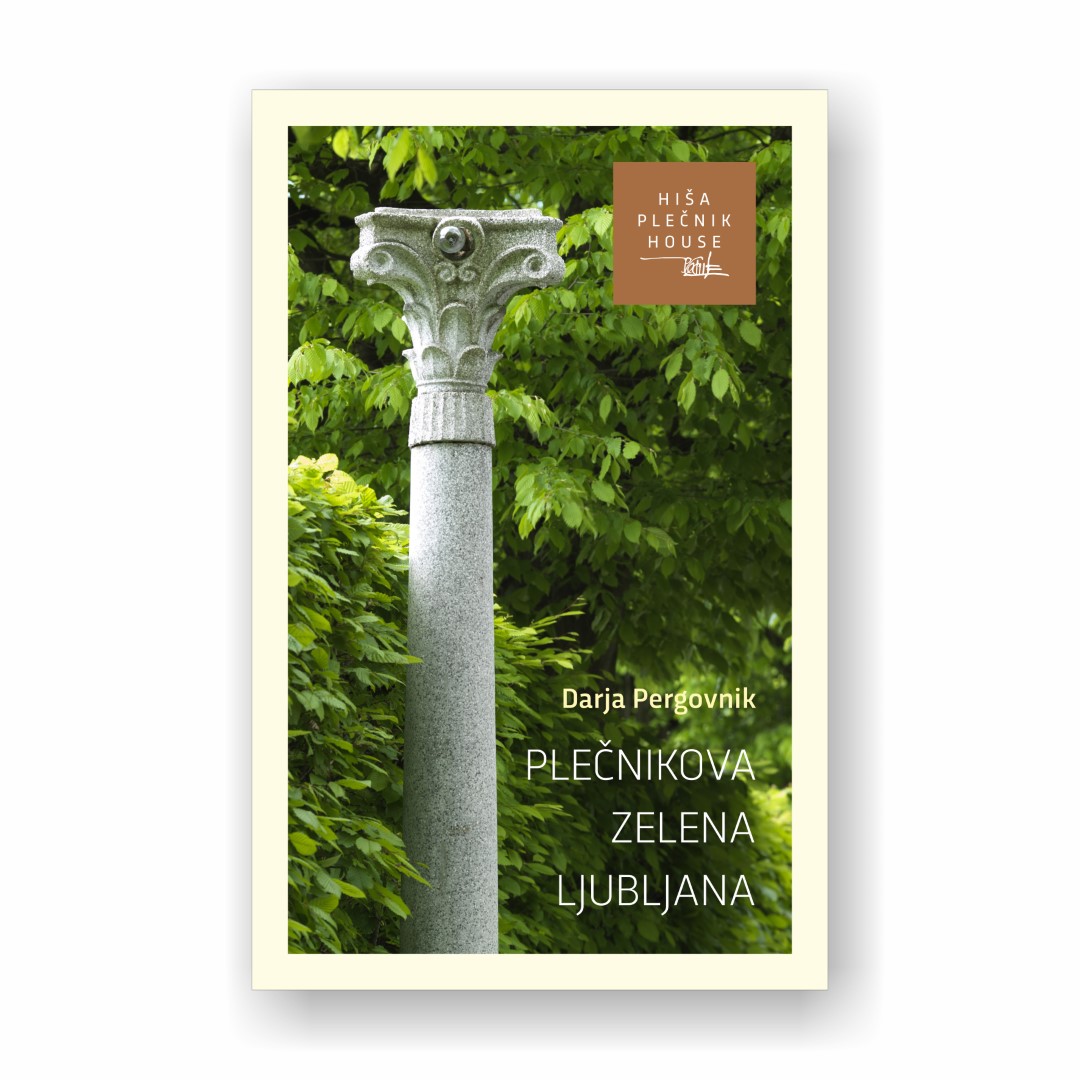
Plečnik’s Green Ljubljana
Plečnik’s open-space design
The book Plečnik’s Green Ljubljana takes an innovative approach to 54 known, lesser-known, or newly discovered Plečnik-designed open spaces in Ljubljana, as seen through the eyes of a landscape architect.
The author, Darja Pergovnik, MA, a landscape architect working at the Institute for the Protection of Cultural Heritage of Slovenia, has long encountered concrete questions regarding the creation and restoration of Plečnik’s works. Due to the lack of data, she embarked on a systematic 20-year research effort, which has now been developed to a level suitable for publication.
Avaliable only in Slovene!
Sold out
In Plečnik’s Green Ljubljana, the context of the pre-existing environment, before the architect’s open space interventions, is first analysed. The book examines different versions of Plečnik’s plans, compares them to the final execution, and describes their present condition. Their key features or distinctive elements are summarised at the end. The study also includes contemporary press coverage, which critically assessed or defended Plečnik’s designs. These publications also reveal intricate details of the plans, often almost at the level of technical reports, while public opinion articles remain relevant and comparable to today’s discourse. The book also explores Stele’s descriptions and justifications of Plečnik’s often radical works.
“Plečnik’s oeuvre in Ljubljana is extensive and diverse, and has been examined in detail in numerous books, scholarly texts, and exhibitions. Yet his work on the design of open space receives considerably less attention, even though this aspect – one of the key chapters of Plečnik’s creative output, significantly contributed to the inclusion of several of his works on the UNESCO World Heritage List. In Ljubljana, more than sixty of his works have been declared cultural monuments of national importance, and many of these include open-space arrangements, while in other cases such arrangements stand as entirely independent units. Plečnik designed parks and gardens and shaped streets, squares, and riverbanks, thereby co-creating the city’s public space. In the urban plan “Regulation Study of Ljubljana and Its Environs” from 1928, as an excellent connoisseur of the city, he proposed numerous arrangements that were later carried out, mostly on the basis of more detailed plans. These designs did not arise spontaneously or merely from the ideas of a gardener, as is often claimed, but were executed according to plans drawn in several variants and usually revised once more just before construction.”
Mag. Darja Pergovnik
Museum and Galleries of Ljubljana, Plečnik House
For the publisher: Blaž Peršin, Director
Editor: Maja Kovač
Author of texts: Mag. Darja Pergovnik
Foreword: Dr. Peter Krečič
Expert support: Ana Porok
Publication production: Maja Kovač
Photography:
Tadej Hrženjak, Peter Naglič, Andrej Nolda,
Maja Kovač, Matevž Paternoster, Darja Pergovnik,
Blaž Zupančič, Els ZWEEring / Iconic Houses,
MGML / Plečnik Collection Archives,
Dolenjski muzej Novo mesto, Moderna galerija Ljubljana,
Museum of Contemporary History of Slovenia,
Museum of Architecture and Design,
National and University Library,
Slovene Ethnographic Museum,
Šolski center Ljubljana, Športno društvo Narodni dom,
Institute for the Protection of Cultural Heritage of Slovenia,
Zgodovinski arhiv Ljubljana
Design: Bojan Lazarevič, Agora Proars
Layout: Marjan Božič
Language editing: Katja Paladin
Print: R-tisk
Print run: 800 copies
December 2024